
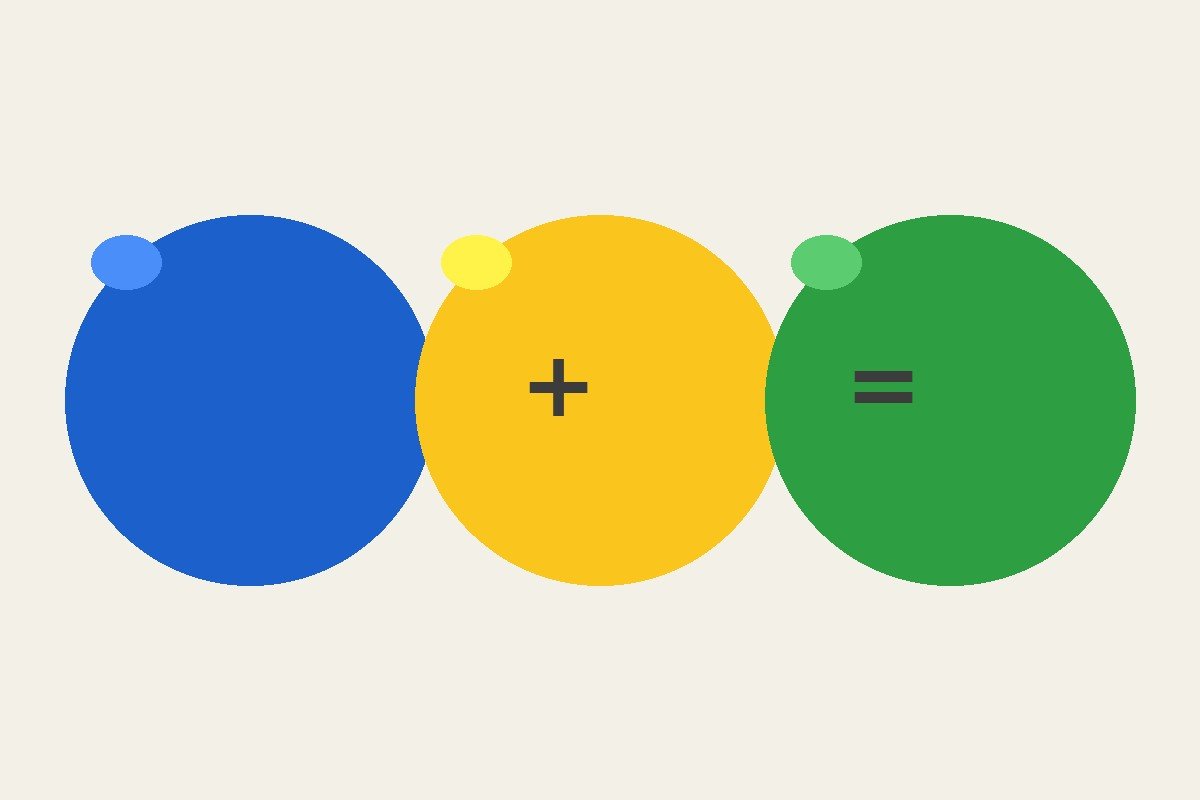
Quick Answer: Two colors make green: blue and yellow. Green is a secondary color created by mixing those two primary colors in paint, pigment or ink. More yellow gives you lime and chartreuse; more blue gives you teal, emerald and forest green. Add white for tints like mint, black for deep shades, or red to mute it into olive.
What Colors Make Green?
The short answer never changes: blue plus yellow equals green. In traditional color theory, red, blue and yellow are the three primary colors — they cannot be created by mixing other colors. When you mix any two of them, you get a secondary color: red and yellow make orange, red and blue make purple, and blue and yellow make green. Everything else in this guide — every shade from neon lime to deep forest — is just a variation on that one pairing, adjusted by ratio, temperature and the small additions of white, black, gray or a complementary color. Reference guides such as Color Meanings’ green mixing guide start from exactly the same blue-plus-yellow foundation.
Why Do Blue and Yellow Make Green?
Paint mixing is called subtractive color mixing, because pigments subtract (absorb) parts of the light spectrum and reflect the rest to your eyes. Yellow pigment absorbs blue light and reflects red and green wavelengths. Blue pigment absorbs red light and reflects blue and green. Mix the two pigments together and the only wavelength both of them reflect is green — so green is what you see. This is also why the specific paints you choose matter: a blue that leans green (like phthalo blue) and a clean, bright yellow produce a vivid green, while a blue that leans purple and a dull, earthy yellow can produce a muddy, grayish green instead.
How Do You Mix Different Shades of Green?
Once you know the two parent colors, the ratio does the creative work:
| Shade of Green | How to Mix It |
|---|---|
| Basic medium green | Roughly equal parts blue and yellow; a common starting point is about two parts yellow to one part blue with strong pigments |
| Lime / chartreuse | More yellow than blue — roughly three parts yellow to one part blue |
| Teal | More blue than yellow, with a blue that already leans green |
| Emerald | Balanced blue and yellow with a touch of white for luminosity |
| Forest / hunter green | Blue-heavy green darkened with a small amount of black |
| Mint / pastel green | Any green plus generous white |
| Olive | Green muted with a touch of brown, or a tiny amount of its complement, red |
| Sage | Green softened with gray and white for a dusty, muted tone |
Two rules save beginners a lot of paint. First, always mix a little at a time and test a swatch, because paint usually dries slightly darker than it looks wet. Second, add the stronger pigment gradually — blue in particular can overpower yellow very quickly, so start with yellow and stir blue in by degrees.
Step by Step: How to Mix Green Paint
If you are standing at an easel or a paint counter, here is the practical sequence that turns the theory into a reliable color:
- Step 1 — Start with yellow. Put out a generous blob of your yellow first. Yellow is the weaker partner in the mix, so beginning with it stops the blue from taking over before you have begun.
- Step 2 — Add blue a little at a time. Load a corner of your knife or brush with blue and stir it in fully before adding more. Watch the color travel: yellow-green, then spring green, then a true medium green, then toward teal. Stop one step before the shade you want, because the final addition always lands stronger than expected.
- Step 3 — Test a dry swatch. Paint a small patch on scrap paper or the wall and let it dry. Most paints dry a shade darker and slightly less vivid, and judging the wet puddle alone is the most common reason a room ends up greener than planned.
- Step 4 — Adjust the temperature. Too cold and blue? Warm it with a dot of yellow. Too yellow and sharp? Cool it with a dot of blue. Adjust in dots, not dollops.
- Step 5 — Adjust the value and intensity. White lightens (tint), a speck of black or deep blue darkens (shade), gray softens (tone), and a whisper of red mutes the green toward olive or moss.
- Step 6 — Write the recipe down. Even a rough note — “3 parts lemon yellow, 1 part phthalo blue, touch of white” — is the difference between a shade you can recreate and a happy accident you will chase for an hour next time.
Does the Type of Blue and Yellow Matter?
Yes. Painters talk about color bias — the direction a pigment leans on the color wheel. Ultramarine blue leans slightly violet, so mixed with a warm yellow it can turn dull. Phthalo blue leans green, so it makes brilliant, almost neon greens with lemon yellow. Cadmium yellow is warm and opaque; lemon or Hansa yellow is cooler and cleaner. The most reliable all-purpose recipe is a green-leaning blue with a clean primary yellow. If your green keeps coming out muddy, the pigments — not your technique — are usually the problem.
What About Mixing Green in Light and on Screens?
Here is the twist that confuses people: the blue-plus-yellow rule belongs to pigments, not light. Screens use additive mixing with red, green and blue light — in that system green is a primary color, and blue light mixed with yellow light produces a whitish result, not green. Printers use CMYK, where green is produced by combining cyan and yellow inks. So the correct answer depends on the medium: paint and pigment, blue plus yellow; print, cyan plus yellow; screens, green is already one of the three base lights and is specified directly with its RGB or hex value.
Common Mistakes When Mixing Green
- Adding too much black: Black kills green’s vibrancy fast. To darken green naturally, try a touch of its complement (red) or a deep blue instead.
- Ignoring pigment bias: A violet-leaning blue and an orange-leaning yellow pull against each other and create mud.
- Mixing on the canvas in poor light: Greens shift dramatically under warm indoor bulbs. Check your mix in daylight before committing.
- Expecting one recipe to fit all: Lime, emerald, olive and sage are all green, but each needs its own ratio and its own finishing touch of white, black, gray or complement.
If your kids want to see color mixing in action, hands-on projects beat lectures — food coloring in frosting for treats like the ones in our caterpillar treats guide shows the blue-plus-yellow transformation in seconds, and activity kits such as The Happy Trunk build whole afternoons around it.
Pros and Cons of Mixing Your Own Green
| Pros | Cons |
|---|---|
| Any shade is possible, including exact matches for a room or brand | Recreating the identical shade later is hard without notes |
| Cheaper than buying dozens of pre-mixed tubes | Biased or low-quality pigments can turn mixes muddy |
| You learn color theory by doing, not memorizing | Large batches for walls are risky — a wrong ratio covers a whole room |
Verdict
What colors make green? Blue and yellow — full stop. That single fact, plus control of the ratio and small additions of white, black, gray or red, unlocks the entire green family from lime to olive. Pick a clean yellow and a green-leaning blue, mix gradually, test dry swatches in daylight, and write your winning ratios down. Mixing your own green is one of the simplest skills in color theory and one of the most satisfying to watch happen on the palette.
Frequently Asked Questions
What two colors make green?
Blue and yellow. Green is a secondary color made by mixing those two primary colors in paint, pigment or dye.
What colors make dark green?
Start with a blue-heavy blue-and-yellow mix, then deepen it with a very small amount of black — or, for a richer result, a touch of dark blue or a hint of red, which darkens green without making it look flat.
What colors make light green or mint?
Mix blue and yellow as usual, then add white. The more white you add, the paler and more pastel the green becomes; a yellow-leaning base gives a fresh, minty result.
Can you make green without blue paint?
With pigments, you need a blue component — but it does not have to come from a tube labeled “blue.” Cyan works in printing (cyan plus yellow), and blue-green pigments such as phthalo green can be adjusted with yellow. There is no way to mix a true green from red and yellow alone; that pairing makes orange.
Why did my blue and yellow mix turn brown or muddy?
Almost always pigment bias: your blue leaned violet or your yellow leaned orange, so the hidden red component in the mix neutralized the green. Switch to a cleaner yellow and a green-leaning blue such as phthalo, and the mix will brighten.